
Nanodiagnostic
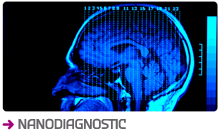
This area is focused around the implementation of more efficient diagnostic and prognosis devices, both in vivo and in vitro, with the objective of optimizing the identification of diseases or predisposition to them, as well as it’s progression at a cellular or molecular level by using nanodevices.
- New detection procedures. Including fundamental research such as the development of new materials, structures, systems or devices at a nanometric scale which allows the detection of a disease at early stages, both in vivo and in vitro. This section includes those nanodevices that are able to detect biological processes (enzymatic reactions, DNA hybridization, presence of proteins, …) or environmental changes (pH, temperature,..)
- New measurement procedures. Study and development of novel nanosensors for analytical concentration measurements, biomolecular interactions and thermic, electronic, magnetic or chemical stimuli.
- Study and development of new contrast agents at a nanometric scale which contribute to achieving a higher sensitivity and specificity to the current diagnostic techniques for disease.
- Approval and development of Lab-on-a-Chip systems or nanomechanical biosensors for biomarkers.
- Nanostructure research for cell and molecule visualization.